Chemical Reactions and Equations: Fundamentals and Applications

- Description
- Curriculum
- FAQ
- Reviews
- Grade
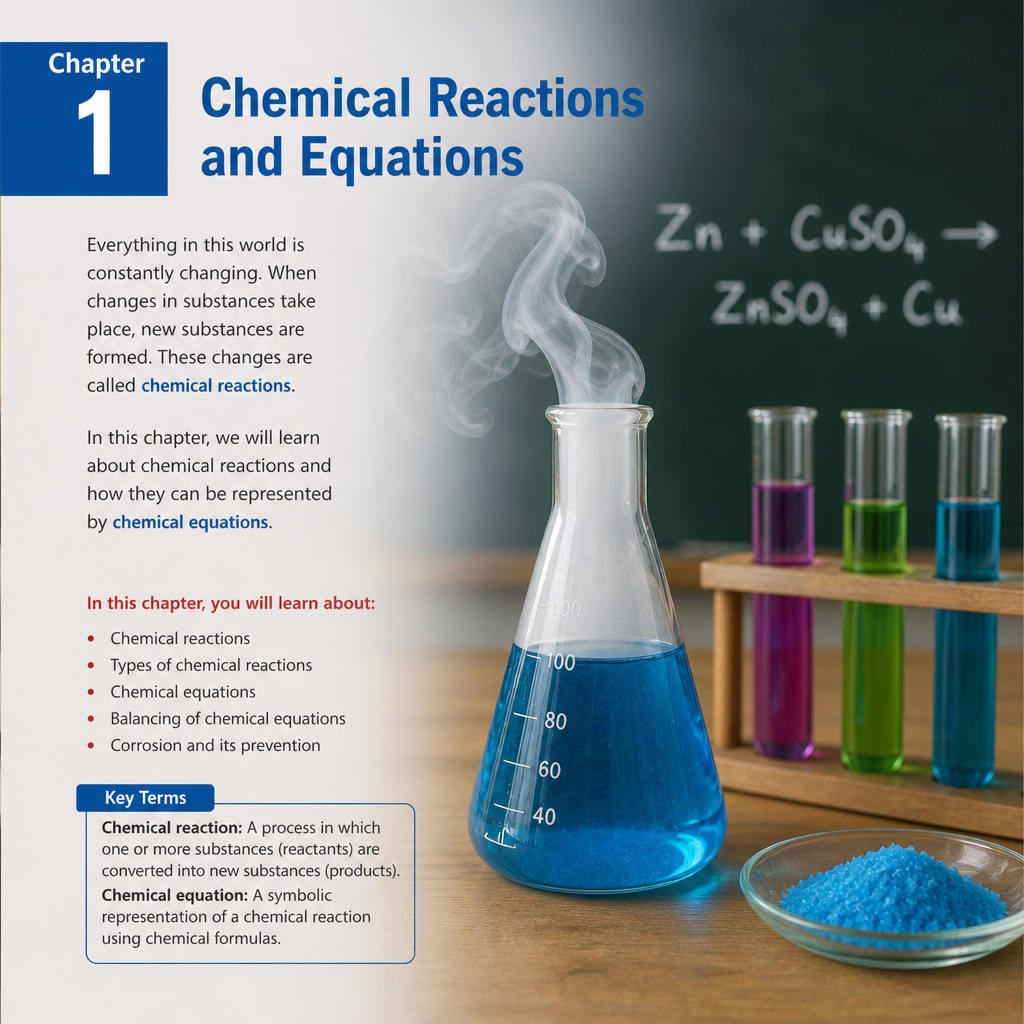
Chapter 1: Chemical Reactions and Equations
Introduction
Chemical reactions are processes in which one or more substances change into new substances with different properties. The substances that take part in a reaction are called reactants, while the new substances formed are called products. Chemical reactions occur around us every day, such as digestion of food, rusting of iron, burning of fuels, and the preparation of medicines.
Recognizing a Chemical Reaction
A chemical reaction may be identified by one or more observable changes. These include a change in colour, formation of a gas, change in temperature, formation of a precipitate, or a change in state. For example, when magnesium burns in air, it produces a bright white flame and forms a white powder called magnesium oxide.
Word equation: Magnesium + Oxygen → Magnesium oxide
Chemical equation: 2Mg + O2 → 2MgO
Writing Chemical Equations
A chemical equation represents a reaction using symbols and formulae. The reactants are written on the left and the products on the right. An arrow separates them and shows the direction of the reaction. Conditions such as heat, light, or a catalyst may be written above the arrow.
For example, hydrogen reacts with oxygen to form water:
H2 + O2 → H2O
This equation is not balanced because the number of oxygen and hydrogen atoms is different on both sides. A balanced equation is:
2H2 + O2 → 2H2O
Balancing Chemical Equations
Equations must be balanced according to the law of conservation of mass. This law states that matter cannot be created or destroyed during a chemical reaction. The number of atoms of each element must therefore be equal on both sides of the equation.
To balance an equation, change only the coefficients placed before chemical formulae. Never change the small numbers, or subscripts, inside a formula because doing so changes the substance itself.
Types of Chemical Reactions
- Combination reaction: Two or more substances combine to form one product.
CaO + H2O → Ca(OH)2 - Decomposition reaction: One compound breaks down into simpler substances.
CaCO3 → CaO + CO2 - Displacement reaction: A more reactive element displaces a less reactive element.
Zn + CuSO4 → ZnSO4 + Cu - Double displacement reaction: Two compounds exchange ions to form new compounds.
AgNO3 + NaCl → AgCl + NaNO3 - Combustion reaction: A substance reacts with oxygen and usually releases heat and light.
CH4 + 2O2 → CO2 + 2H2O
Oxidation and Reduction
Oxidation may involve the addition of oxygen or removal of hydrogen, while reduction may involve the removal of oxygen or addition of hydrogen. These processes occur together and are called redox reactions. Rusting is an example of oxidation, in which iron reacts with oxygen and moisture to form rust.
Chapter Summary
Chemical reactions produce new substances and can be represented using equations. Equations must be balanced to follow the law of conservation of mass. Important reaction types include combination, decomposition, displacement, double displacement, and combustion. Observing changes and writing balanced equations helps us understand chemical processes in the laboratory and in everyday life.
-
1
 What Is a Chemical Reaction?Students will learn what a chemical reaction is and how it transforms one or more substances into new substances with different properties. They will explore key signs of chemical change and distinguish chemical reactions from physical changes using familiar, real-world examples.
 -
2
 Recognizing Chemical ChangesStudents will learn how to recognize chemical changes by identifying evidence that a new substance has formed, such as color change, gas production, temperature change, or the formation of a precipitate. They will use observations from everyday examples and investigations to distinguish chemical changes from physical changes.
 -
3
 Introduction to Chemical Reactions Quiz
 -
4
 Spotting Chemical Changes in Everyday Life
-
5
Reactants, Products, and Chemical FormulasStudents will learn how to identify reactants and products in a chemical reaction and distinguish their roles in forming new substances. They will also interpret and use chemical formulas to represent the substances involved in chemical reactions.
-
6
How to Write a Word EquationStudents will learn how to write word equations that represent chemical reactions using the names of reactants and products. They will practice identifying the substances involved and arranging them correctly to describe what happens during a reaction.
-
7
Writing Chemical Equations Quiz
-
8
Converting Word Equations into Chemical Equations
-
9
The Law of Conservation of MassStudents will learn that matter is neither created nor destroyed during a chemical or physical change, though it may be rearranged into new forms. They will use the Law of Conservation of Mass to compare the mass of substances before and after a reaction and explain why the total mass remains constant.
-
10
Steps for Balancing Chemical EquationsStudents will learn a clear, step-by-step process for balancing chemical equations while applying the law of conservation of mass. They will practice identifying elements, adjusting coefficients, and checking their work to ensure each equation is accurate and balanced.
-
11
Balancing Chemical Equations Quiz
-
12
Balancing and Interpreting Chemical Equations
- Course title: Chapter 1 - Chemical Reactions and Equations
- Subject: Chemistry
- Level: Secondary school
- Topics include chemical reactions, word equations, and balanced chemical equations
- Learning focus: identifying, representing, and interpreting chemical changes
- Basic understanding of elements, compounds, and mixtures
- Familiarity with chemical symbols and common formulas
- Ability to read and write simple chemical equations
- Access to a chemistry textbook or learning materials
- A notebook and calculator for practice activities
- Secondary school students studying introductory chemistry
- Learners beginning the study of chemical reactions and equations
- Students preparing for school-level chemistry examinations
- Anyone seeking a foundational understanding of chemical changes
- Teachers or tutors looking for structured introductory chemistry content